
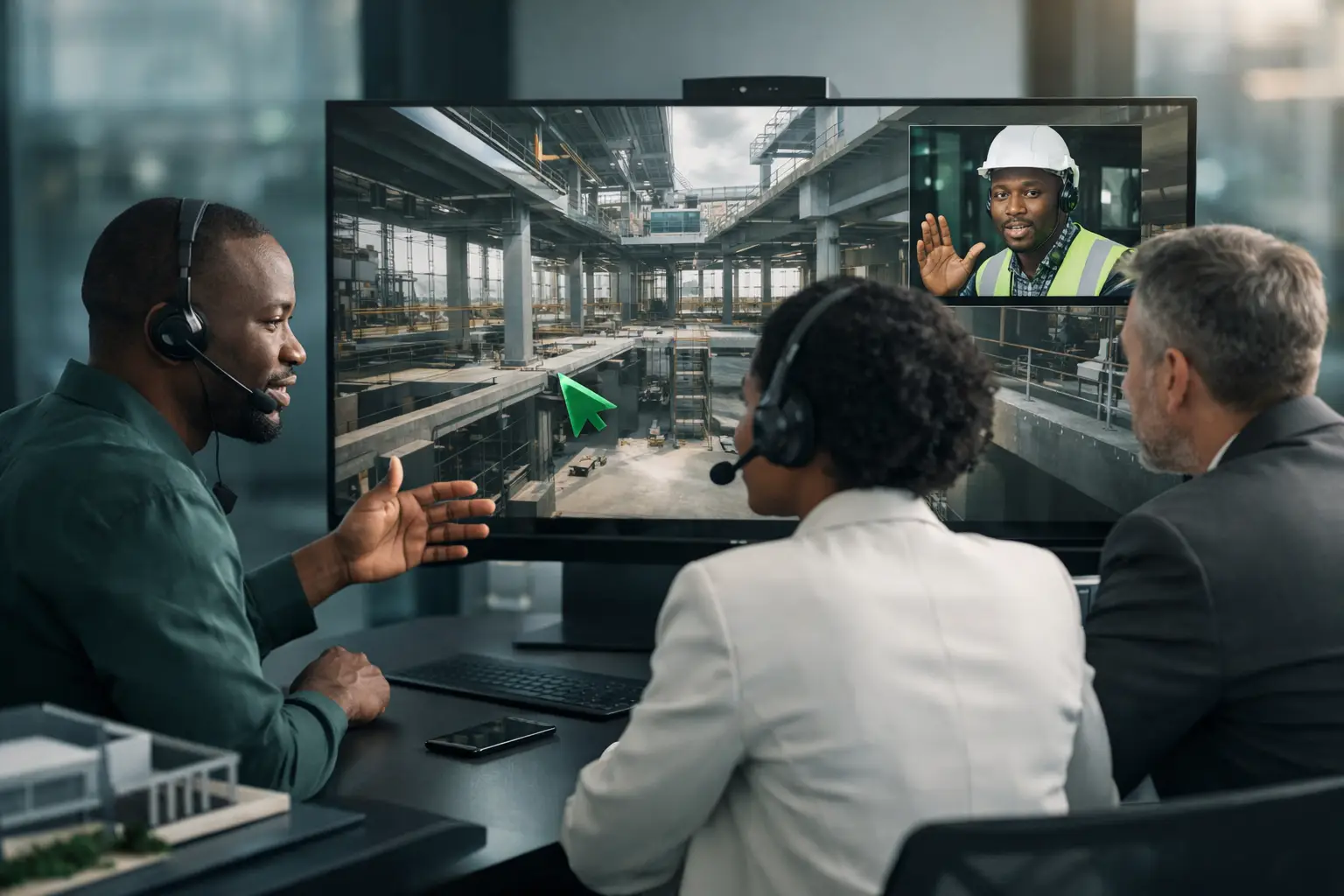
A vacant hotel wing in Douala, a construction milestone outside Nairobi, or a dealership showroom in Lagos can be difficult to review when the decision-maker is elsewhere. Photos provide selected evidence. Video calls often drift, lose context, and depend on whoever is holding the phone. A live guided 3D call gives stakeholders a more credible alternative: a live conversation inside a captured digital environment that preserves the space, its layout, and the details that matter.
For organizations managing assets across cities, countries, or dispersed project teams, this is not simply a better virtual tour. It is a practical layer of remote access. A host can guide participants through a property, facility, or site while everyone sees the same navigable 3D model, asks questions at the relevant location, and returns to the digital record after the call.
What a guided 3D call changes
A standard video meeting shows what the camera operator chooses to show at a given moment. That can be useful for a quick update, but it has limits. Participants may not understand where they are in the building, how one room relates to another, or whether a visual detail has been omitted unintentionally. Network interruptions can also turn an inspection into a fragmented conversation.
A guided 3D call begins with a spatially captured environment. The host and participants enter a shared digital twin or immersive walkthrough, moving through rooms, floors, public areas, work zones, or service spaces with a consistent visual reference. Dollhouse views and floor plans can clarify orientation, while interactive hotspots can bring attention to a room specification, a construction issue, an asset, or a supporting document.
The difference is operational. Rather than asking, “Can you turn around and show the corridor again?” a funder, investor, project manager, or prospective tenant can review the corridor in context. Rather than scheduling multiple site visits for early-stage screening, a team can use the call to decide whether an in-person visit is necessary and what it should focus on.
This matters especially where mobility is expensive, access is restricted, or stakeholders are distributed across markets. It also matters when a site needs to be presented with professional control. A guided session can follow a clear agenda, answer questions in real time, and leave participants with a durable visual record instead of a collection of screenshots and recollections.
Where live guided 3D calls deliver value
For commercial real estate, guided calls help brokers and owners qualify serious prospects before arranging site visits. A leasing team can walk an occupier through entrance access, common areas, fit-out potential, parking, views, and technical spaces. For investors based outside the country, the session can bring local asset knowledge and visual evidence into the same conversation.
In hospitality, the use case extends beyond room sales. Hotel operators can show event planners how a conference area connects to reception, breakout rooms, catering access, and guest circulation. Owners can present renovated areas to brand partners or remote management teams without waiting for travel schedules to align. The quality of the capture matters here: guests and commercial partners need an accurate sense of scale, finish, and flow, not a heavily edited promotional clip.
Construction and infrastructure teams can use guided 3D calls to review progress against defined milestones. A captured baseline creates a reference point. Subsequent scans or visual updates make it easier to discuss what has changed, identify incomplete areas, and communicate status to clients, consultants, funders, or internal leadership. It does not replace engineering certification, site safety controls, or formal quantity verification. It strengthens visual reporting by giving discussions a location-specific record.
For facilities and industrial environments, the value is often access and documentation. A facilities manager can guide a remote service provider through an equipment room, warehouse, office floor, or production-support area before dispatching a team. An institution can orient new staff, support security planning, or document conditions before a renovation. In public and development-sector projects, a guided review can help nontechnical stakeholders understand a site without reducing the conversation to technical drawings alone.
Automotive dealerships have a distinct opportunity. A live 3D call can connect a buyer, fleet customer, or manufacturer representative to the showroom experience remotely. The host can show vehicle display zones, service reception, customer lounges, and available inventory information in an organized environment. The result is more credible than a series of isolated vehicle photos and more scalable than relying solely on physical appointments.
A digital twin is only as useful as the call design
The technology creates the environment, but the value of a guided call depends on how it is prepared. A poorly planned session can still become a generic tour. The strongest calls begin with a decision: What must participants be able to assess by the end of the meeting?
For a property prospect, that may be suitability, access, condition, and next steps. For a construction review, it may be progress at defined work packages and any issue requiring escalation. For an NGO or public agency, it may be evidence that a facility, intervention site, or community asset is accessible, complete, and aligned with a reporting milestone.
The host should build the route around that decision. Start with location and overall orientation, then move through the areas that answer the stakeholder’s questions. Use the floor plan when spatial relationships matter. Pause at specific points rather than trying to cover every square meter. If documentation is available through hotspots or supporting materials, introduce it when it helps clarify an observation rather than overwhelming participants at the start.
There is also a trade-off between a highly polished presentation and an honest inspection. Marketing calls benefit from clear staging, good lighting, and a route that emphasizes strengths. Due diligence, compliance, or project-progress reviews require a more complete picture, including constraints, unfinished work, and access limitations. The right balance depends on the call’s purpose. A credible 3D environment should support transparency, not conceal inconvenient details.
What stakeholders should expect before the session
A professional guided 3D call is most effective when the underlying capture is current, complete enough for the intended decision, and hosted securely. Before scheduling the session, confirm the date of capture, the areas included, and any sections that are restricted or unavailable. For active construction sites, agree on the milestone being represented so that participants do not mistake an earlier condition for current progress.
It is also useful to identify who needs to attend. A property decision may involve a broker, owner, tenant representative, and investor. A project review may require the contractor, architect, client representative, and funder. Bringing the right people into one structured session can eliminate long email chains and competing interpretations of the same site condition.
Participants do not need specialized spatial-technology knowledge. They do need a stable internet connection, a suitable screen, and a clear agenda. Larger screens are preferable when reviewing floor layouts, finishes, or detailed site observations. The host should allow time for questions and record agreed actions separately, since a 3D call is a visual review environment, not a substitute for formal meeting minutes or contractual instruction procedures.
From remote viewing to durable evidence
The strategic benefit of live guidance is not limited to the meeting itself. After the call, stakeholders can revisit the relevant digital environment to verify what was discussed, share the experience with colleagues who could not attend, or prepare for a targeted physical inspection. This continuity is what turns a virtual walkthrough into a working asset.
For organizations with multiple properties, sites, or facilities, the approach can be standardized. Consistent capture specifications, naming conventions, milestone dates, and access controls make it easier to compare locations and maintain an accessible archive. Over time, visual records can support property marketing, asset handover, maintenance planning, stakeholder reporting, and project governance.
IMMOBITRON approaches this work as spatial intelligence rather than a one-off visualization exercise. LiDAR-informed capture, immersive navigation, structured documentation, and guided review can be combined according to the needs of a single site or a multi-location program. The useful question is not whether every space needs a 3D call. It is which decisions become faster, clearer, and better evidenced when the right people can inspect that space together.
When a site visit is necessary, it should be worth the journey. A well-prepared guided 3D call helps teams arrive with sharper questions, clearer priorities, and a shared understanding of the space before they step through the door.